Search This Blog

Showing posts with label Independent Reading. Show all posts

Friday, August 19, 2016

Tip #3: Goldilocks and the Just Right Book

A Lesson from Goldilocks

Remember the story about Goldilocks and the Three Bears?

The first bed was too hard, the second was too soft and the third was just right?  Well, choosing a "just right" book is the same idea as finding the right bed!

The easiest way is to help your child find the right book is to use the Five Finger Rule:


Here's how you do it:  


1. Pick a book that your child would like to read.

2. Ask your child to start reading aloud to you.

3. Keep track of words missed (one finger up for each word that he/she is not able to read correctly).

Trying it Out


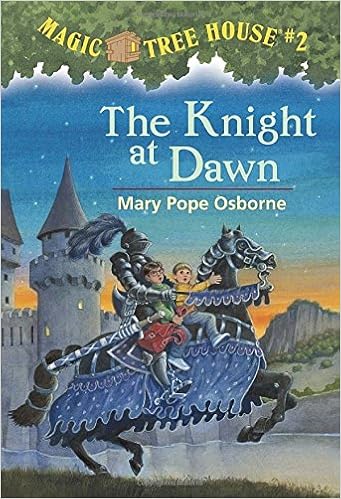
I decided to try this out with Joey, for help in writing this post but also to check in on his reading. We used book #2 of the popular Magic Tree House Series, The Knight at Dawn, by Mary Pope Osborne.

Joey turned to Chapter 8 - The Knight and began reading.  Here are the words that he struggled with on the first page of the chapter:

coughed
flailed
afloat

According to the chart above, he missed three words.  So this book is probably a little bit above his "Just Right" level, although I think he can still read it with support.

The key is that when your child reads alone (or with your support), that the book is not TOO hard.  That will only result in frustration, for you and himher. Comprehension will be lost, tears may be shed and reading will not be enjoyable.  (Although a challenge book is a perfect read aloud that YOU can read to your child).

A Note on Easy Books: It's okay to read easy books sometimes, especially to practice fluency and foster a love of reading.  But if children only read easy books, they won't challenge themselves to use reading strategies and skills to decode new words and comprehend harder texts.


Comprehension is still King


We all know that the main reason to read is to make meaning and understand the text.  So of course, noting misread words is not the only reading behavior to notice with your child.  Asking a couple general comprehension questions is also a great guide as to whether or not the book is appropriate.  For example,


  • What just happened on this page?
  • What do predict will happen next?
  • What do you think this _[insert word]_ means?

If they can read the words but don't seem to "get" what's going in on the story, than have him/her move to an easier text when reading independently.  Or, provide scaffolding by reading the book together.

What is a Leveled Text?


If your child's independent reading level is available from their teacher,  you can also use that as a guide.  Many schools use the Fountas and Pinnell Leveling System, which is a system that follows the letters of the alphabet, with A being the easiest.

Once you have the level, use the link below to check a book.   Curious to see the actual difficulty of The Knight at Dawn, I popped the title into the site below.

Scholastic Book Wizard

This book is a Level M, which according to the Fountas and Pinnell link above, is an end of 2nd grade book.  Which makes sense that is was above his level, since he is just about to enter 2nd grade.

The point here is not to police your child's reading level but to check in when he/she is reading indepedently.  If she/he misses 5 or more words on a page, it's probably not a good book to read alone.  Instead, choose a different book or read it together. 

They're just words...


When Joey and I finished Chapter 8 in The Knight at Dawn, I offered him some praise.  I was careful to use my "mommy" voice and not my "teacher" persona. (Earlier this summer, both kids told me to stop sounding like a teacher.  "You're not a teacher in the summer," they informed me.  "You're just our mom.")

So here's what I said to Joey this time around:

"Wow, you figured out some tricky words," I said.  "You're a good reader!"

He smiled.

"Now remember, when you see big, scary words, like afloat or flailed, just stop and take your time.  Just like we did together today."

He laughed, like I had just said the craziest thing in the world.  "Why are you calling them scary words?  They're not monsters or something.

"They're not scary, Mommy.  They're just words."

I gave him a hug and smiled too.

Just words.  

My point exactly...


Wednesday, July 27, 2016

What is Summer Slide?

You've probably heard these words before, the term for what happens when children lose approximately two months of academic gains over the summer.  Instead of maintaining their progress from the prior school year - or possibly gaining ground and moving ahead - they slide backwards.  Hence, the famed Summer Slide.

What is the impact?

Research suggests that when children don’t read over the summer, they can fall behind by more than two years by 5th grade.  http://www.cli.org/blog/5-tips-for-preventing-summer-slide-2/ (Links to an external site.)

Other data suggests an even greater effect:

“Summer reading loss accounts for roughly 80% of the reading achievement gap between more and less economically advantaged children” and this gap, which builds over a child’s school career, can be greater than four academic years, a staggering difference especially when considering the demands of the Common Core State Standards.” (School Library Journal, 2013)


So how will we do this?  How will we keep our students - and children - reading and writing over the summer?  How will we combat the evil Summer Slide?

How can this blog help?


Here's where this blog comes in.  The purpose is to provide tips on how to engage your child with literacy over the summer.  When we integrate literacy into the framework of our daily lives, we model for children the real purpose that reading and writing serves for us. Now, I know that it's already July but we still have almost half of the summer left.  So please stay with me!  And of course, many of these ideas will help to enhance their school year experience as well.

Don’t get me wrong.  I agree that summer should be a time for kids to relax, have fun and take a break from the demands of regular school.  To catch fireflies at night, swim at the pool or ride bikes to the park.  A time to be silly, in unstructured, playful ways.  To be kids. So I'm not suggesting that we require a school-like schedule for them during the summer, with rigid requirements for math, reading and writing.  But a little time to practice concepts learned - in an engaging, authentic and meaningful manner - will go a long way.

In each new post, I will share a new strategy, tip or idea, one that is practical and easy to implement at home, without requiring a specific background or teaching expertise.  It's a no brainer that daily independent reading is critical so you will see that included in multiple ways, such as how to find "just right" books, how to discuss books with your child and how to ride the wave of summer library programs.  One of my favorite Richard Allington quotes is this: "If they don't read much, how they ever gonna get good?"

Enough said.  

And did you know that reading aloud is one of the single most important things that you can do to help your child grow as a reader? (and writer)?  So you will find info on that here as well.

Finally, keeping children active as writers can often feel like a chore.  (Have you ever felt that way??)  My hope is that over the course of these posts, you will find easy and simple ideas to keep your child writing at home, from grocery lists, to summer journals and even outdoor sketching.

These ideas are by no means the be all, end all of what you can try.  But they are a place to start, to dip your toes in the water. (I meant that figuratively, of course, but since it's summer, maybe that will take on a literal meaning as well!).  

Above all, I hope that you find the posts here to be meaningful, relevant and inspiring.  And I would love to hear your comments so please share your own thoughts here (i.e. what worked well, what didn’t work, additional strategies that you have tried, etc.).  Let's begin partnering together now to beat Summer Slide and instead help our children continually grow as readers and writers.

Welcome!